
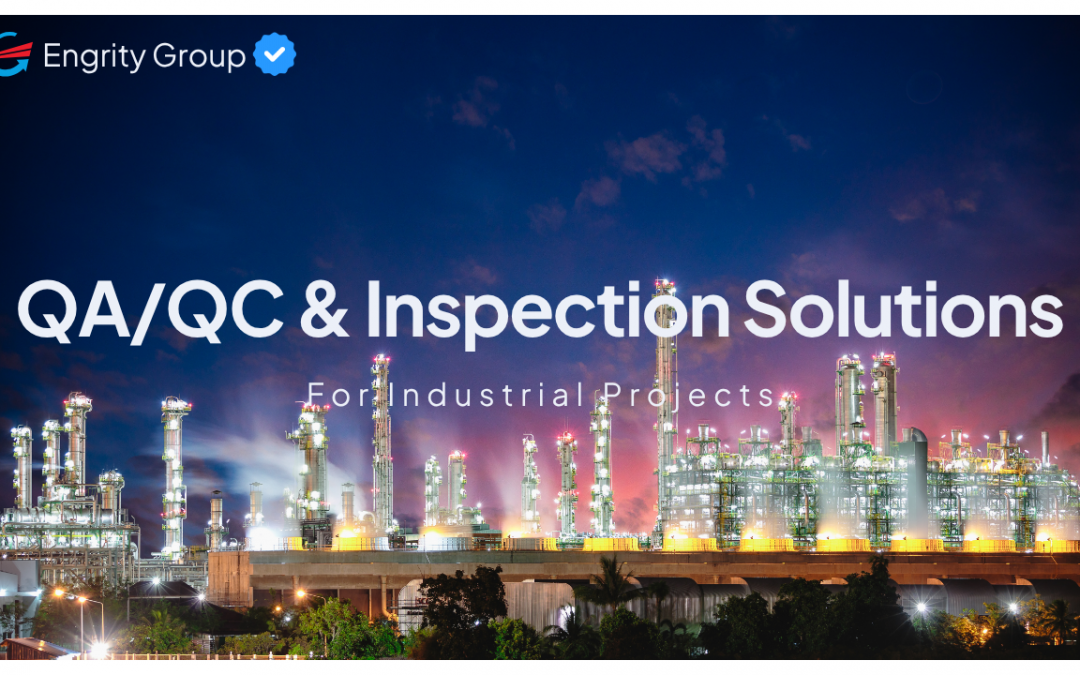
Delivering Quality. Reducing Risk. Driving Project Success.
Hello Industrial Partners!
Why Quality Assurance and Quality Control Matter More Than Ever in Today’s Industrial Environment?
In today’s highly competitive construction, industrial, manufacturing, energy, and infrastructure sectors, organizations are under constant pressure to deliver projects safely, on schedule, within budget, and in compliance with increasingly stringent regulatory requirements.
Despite advancements in technology, project management methodologies, and construction practices, one challenge continues to impact organizations across all industries: quality failures.
Whether it’s a fabrication defect, an installation error, non-conforming materials, incomplete documentation, or inadequate inspection oversight, quality issues can quickly escalate into costly project delays, expensive rework, safety incidents, contractual disputes, and reputational damage.
Many organizations still view quality programs as an overhead expense. However, industry-leading companies understand a fundamental truth:
Quality is not an expense—it is an investment in project success.
A proactive approach to Quality Assurance (QA), Quality Control (QC), and Inspection Services delivers measurable returns through improved project performance, reduced risk exposure, enhanced client satisfaction, and long-term operational reliability.
At Engrity Group, we help organizations establish and maintain quality excellence through comprehensive QA/QC, Inspection Services, Compliance Verification, and Technical Quality Resource Solutions tailored to project-specific requirements.
Understanding the Cost of Poor Quality
The true cost of poor quality often extends far beyond the initial repair or replacement of defective work.
When quality issues are discovered during construction or fabrication, organizations frequently experience a ripple effect that impacts multiple aspects of a project.
Common consequences include:
Project Delays
Defects discovered during inspections often require immediate corrective action, resulting in schedule disruptions and productivity losses. In large-scale industrial projects, even a minor quality issue can affect multiple trades, subcontractors, and critical project milestones.
Costly Rework
Rework remains one of the largest hidden costs in construction and industrial projects. Correcting non-conforming work often requires additional labor, equipment mobilization, material replacement, and management oversight.
Safety Risks
Quality deficiencies can directly impact worker safety and asset integrity. Structural failures, equipment malfunctions, welding defects, and improper installations can increase the likelihood of incidents and injuries.
Compliance Violations
Organizations operating within regulated industries must comply with numerous codes, standards, client specifications, and regulatory requirements. Failure to meet these obligations can result in audits, penalties, project shutdowns, and legal consequences.
Reputation Damage
Clients expect projects to be completed correctly the first time. Recurring quality issues can damage relationships, reduce future business opportunities, and negatively affect an organization’s reputation within the industry.
Numerous industry studies have estimated that the cost of poor quality can range from 5% to 20% of total project costs depending on the complexity of the work and the maturity of the organization’s quality management systems.
The Difference Between Quality Assurance and Quality Control
Many organizations use the terms Quality Assurance (QA) and Quality Control (QC) interchangeably. While they are closely related, they serve distinct functions.
Quality Assurance (QA)
Quality Assurance focuses on preventing defects before they occur.
QA involves establishing systems, procedures, standards, and processes designed to ensure that work is completed correctly from the outset.
Examples of Quality Assurance activities include:
- Development of Quality Management Systems (QMS)
- Procedure development and implementation
- Inspection and Test Plan (ITP) creation
- Internal quality audits
- Supplier qualification programs
- Process improvement initiatives
- Training and competency management
- Risk assessments
QA is proactive.
Its primary objective is to prevent quality problems before they impact the project.
Quality Control (QC)
Quality Control focuses on identifying defects and verifying compliance during project execution.
QC activities include:
- Material inspections
- Welding inspections
- Coating inspections
- Mechanical inspections
- Structural inspections
- Electrical inspections
- Dimensional verification
- Documentation reviews
- Testing and verification activities
QC is reactive and verification-based.
Its purpose is to ensure completed work meets established requirements and specifications.
Why Inspection Services Are Critical to Project Success
Inspection services provide the practical mechanism for verifying quality throughout a project’s lifecycle.
Effective inspection programs help organizations:
- Verify compliance with project specifications
- Confirm workmanship quality
- Validate material conformity
- Identify deficiencies early
- Reduce rework costs
- Improve construction productivity
- Strengthen client confidence
- Support regulatory compliance
Without proper inspection oversight, organizations risk allowing deficiencies to remain undetected until they become major project issues.
Early detection is often the difference between a minor correction and a significant project disruption.
Key Quality Services Every Industrial Project Should Consider
Welding Inspection
Welding is one of the most critical activities within industrial construction, fabrication, and maintenance projects.
Welding inspections verify:
- Welding procedure compliance
- Welder qualifications
- Joint preparation
- Weld quality
- Dimensional requirements
- Code compliance
Effective welding inspections help prevent failures that can compromise structural integrity, pressure systems, and operational reliability.
Mechanical Inspection
Mechanical inspections ensure equipment and systems are installed and operating according to project specifications and manufacturer requirements.
Areas commonly inspected include:
- Pumps
- Compressors
- Piping systems
- Pressure vessels
- Rotating equipment
- Mechanical assemblies
Mechanical quality failures can result in significant operational downtime and repair costs.
Civil and Structural Inspection
Civil and structural inspections verify that foundations, concrete structures, steel assemblies, and related components meet design requirements.
Inspection activities typically include:
- Reinforcing steel verification
- Concrete placement monitoring
- Structural steel inspections
- Bolt torque verification
- Foundation inspections
Proper structural quality management contributes directly to long-term asset integrity.
Coating Inspection
Protective coatings play a critical role in preventing corrosion and extending asset life.
Coating inspections commonly involve:
- Surface preparation verification
- Environmental condition monitoring
- Dry film thickness measurements
- Holiday testing
- Final coating assessments
Proper coating quality significantly reduces lifecycle maintenance costs.
Electrical and Instrumentation Inspection
Electrical and instrumentation systems are essential to operational safety and performance.
Inspection activities may include:
- Cable installation verification
- Instrument calibration checks
- Electrical system inspections
- Loop checks
- Commissioning support
Proper inspection reduces operational risks and startup delays.
The Role of Quality Management Systems (QMS)
A Quality Management System provides the foundation for consistent quality performance across an organization.
An effective QMS helps organizations:
- Standardize processes
- Improve accountability
- Enhance traceability
- Reduce variability
- Strengthen compliance
- Support continuous improvement
Organizations with mature quality systems are generally better equipped to manage complex projects and maintain high performance standards.
A well-implemented QMS also helps organizations meet client expectations and certification requirements such as ISO 9001:2015.
Vendor Surveillance and Supply Chain Quality
Quality management does not begin when materials arrive at a job site.
It begins with supplier selection and procurement activities.
Vendor surveillance programs help organizations:
- Monitor supplier performance
- Verify manufacturing quality
- Review inspection records
- Validate certifications
- Ensure compliance with purchase requirements
Early supplier engagement reduces the likelihood of receiving non-conforming materials and equipment.
Documentation: The Often-Overlooked Component of Quality
Many projects focus heavily on physical inspections while underestimating the importance of documentation quality.
Incomplete or inaccurate documentation can delay project turnover and create compliance concerns long after construction is complete.
Key documentation activities include:
- Material traceability reviews
- Inspection record verification
- Test report validation
- Turnover package preparation
- Regulatory documentation management
Comprehensive documentation ensures project records remain complete, accurate, and auditable.
Building a Culture of Quality
Successful quality management extends beyond inspections and procedures.
It requires a culture where quality becomes everyone’s responsibility.
Organizations that build strong quality cultures often experience:
- Lower rework rates
- Improved productivity
- Higher client satisfaction
- Better safety performance
- Increased employee engagement
- Greater project profitability
Quality becomes most effective when integrated into daily operations rather than treated as a standalone function.
How Engrity Group Supports Project Success
At Engrity Group, we understand that every project presents unique challenges and quality requirements.
Our team provides practical, scalable quality solutions designed to support organizations throughout every stage of the project lifecycle.
Our services include:
- Quality Assurance (QA)
- Quality Control (QC)
- Welding Inspections
- Mechanical Inspections
- Civil & Structural Inspections
- Coating Inspections
- Electrical & Instrumentation Inspections
- Quality Audits
- Inspection & Test Plan Development
- Quality Management System Support
- Vendor Surveillance
- Documentation Review
- Turnover Package Preparation
- Technical Quality Resource Supply
As a COR and ISO 9001:2015 Certified organization, we are committed to helping clients achieve compliance, improve project performance, and reduce operational risk.
Conclusion
Quality is one of the most valuable investments an organization can make.
Projects that prioritize quality experience fewer delays, lower rework costs, improved safety performance, stronger compliance outcomes, and greater client satisfaction.
Whether your organization requires a single QA/QC professional, specialized inspection services, or a comprehensive quality management program, investing in quality today can prevent costly problems tomorrow.
The question is no longer whether organizations can afford quality.
The question is whether they can afford the consequences of operating without it.
Partner With Engrity Group
Ready to strengthen your project’s quality performance?
Contact Engrity Group today to discuss your Quality Assurance, Quality Control, Inspection Services, and Technical Quality Resource requirements.
Email: info@engrity.com
Phone: (780) 800-6297
Engrity Group
Building Confidence Through Quality and Compliance.
Experience the Difference
Contact
Phone
+1 (780) 800-6297
info@engrity.com
Address:
201-9403 63 Ave NW, Edmonton, AB T6E 0G2