
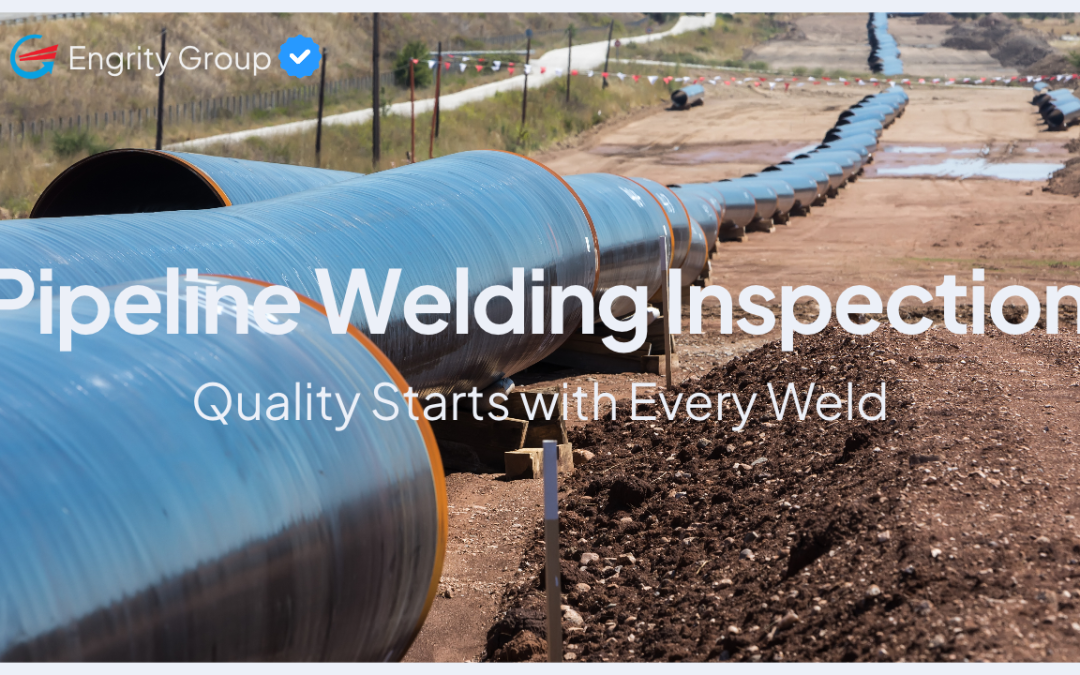
Pipeline Inspection Services: Comprehensive Quality Control, Welding Inspection, NDT and Coating Solutions
Hello Everyone!
Pipeline construction demands precision at every stage. From material verification and pipe fit-up to welding, non-destructive testing, coating application, and final documentation, every activity contributes to the quality, reliability, and long-term performance of a pipeline system.
For pipeline owners, EPC contractors, construction companies, and fabrication teams, maintaining quality is about more than completing individual inspections. It requires a coordinated approach that verifies workmanship, identifies potential issues early, supports compliance with project requirements, and keeps construction activities moving efficiently.
Engrity Group Inc. provides professional inspection and quality control support for pipeline construction, fabrication, and industrial projects across Western Canada. With 15 years of industry experience, we help clients access qualified inspection personnel and project-specific technical support to meet their quality objectives.
Whether you require welding inspectors for field construction, NDT services for weld examination, coating inspection to support corrosion protection, or dedicated QC personnel for an ongoing project, Engrity can help build an inspection solution around your requirements.
1. Why Pipeline Inspection Matters
Pipeline systems operate under demanding conditions. Their reliability depends on the quality of materials, welding workmanship, protective coatings, installation practices, and verification activities throughout construction.
Issues identified late in a project can result in weld repairs, coating removal and reapplication, additional testing, schedule disruptions, and increased costs. Effective inspection helps identify discrepancies while corrective action is still practical.
A well-coordinated inspection program helps project teams:
-
Verify compliance with approved procedures, drawings, specifications, and applicable codes.
-
Identify workmanship issues before they progress to subsequent construction stages.
-
Support early detection and correction of weld and coating deficiencies.
-
Maintain material identification, weld traceability, and quality records.
-
Coordinate inspection activities with construction schedules.
-
Provide documented evidence of inspection results and corrective actions.
-
Support quality handover and project closeout.
Pipeline construction involves interconnected activities. For example, a weld must be completed and accepted under the applicable requirements before the next stages can proceed. Field-applied coating must also be inspected before the pipe is lowered into the trench and buried. These activities demonstrate why welding inspection, NDT, and coating inspection need to work together. (See the U.S. Pipeline and Hazardous Materials Safety Administration’s pipeline construction overview.)
2. Welding Inspection for Pipeline Construction
Welding is one of the most critical activities in pipeline construction. Every joint must be produced in accordance with the approved welding procedure and the applicable project acceptance requirements.
Engrity provides qualified CWB Level 1 and Level 2 Welding Inspectors to support pipeline construction and industrial projects, subject to project-specific qualification requirements.
Our welding inspection support can cover the welding process from joint preparation through final visual examination.
Welding surveillance
Welding surveillance helps verify that welding activities are being carried out in accordance with approved Welding Procedure Specifications (WPS), project specifications, and applicable requirements.
Our inspectors can monitor welding activities, observe workmanship, identify deviations, and communicate quality concerns to the appropriate project representatives.
Fit-up and joint preparation inspection
Before welding begins, proper joint preparation is essential to achieving the required weld quality.
Inspection activities may include verification of:
-
Pipe alignment and fit-up.
-
Root openings and joint geometry.
-
Bevel angles and joint preparation.
-
Joint cleanliness and surface condition.
-
Tack weld condition, where applicable.
-
Compliance with approved drawings and welding procedures.
Identifying fit-up discrepancies before welding helps reduce avoidable rework and supports consistent welding operations.
Welding parameter verification
Welding parameters must be controlled in accordance with the approved procedure and project requirements.
Depending on the welding process and inspection scope, our inspectors can verify and document relevant parameters, including:
-
Welding amperage and voltage.
-
Travel speed, where required.
-
Preheat temperature.
-
Interpass temperature.
-
Other procedure-specific variables and requirements.
Where required by the project, inspectors can use suitable measuring instruments and temperature-measurement equipment to support verification and recordkeeping.
Welder qualification and procedure compliance
Pipeline projects may require verification of welder qualifications, approved welding procedures, and supporting documentation before production welding begins.
Our inspection personnel can support the review of applicable records and verification that the required documentation is available and relevant to the work being performed.
Final visual welding inspection
Following welding, visual inspection helps assess the completed weld against the applicable acceptance criteria.
Inspection may include examination of weld profile, dimensions, surface condition, visible discontinuities, and other specified characteristics.
Where an indication or discrepancy is identified, it can be documented and communicated for evaluation and disposition under the project’s quality procedures.
The objective is straightforward: verify welding quality, identify issues early, and maintain traceable inspection records throughout construction.
3. Non-Destructive Testing (NDT)
Visual inspection provides important information about the external condition of a weld, but it cannot identify every type of discontinuity. Non-Destructive Testing (NDT), also referred to as Non-Destructive Examination (NDE), provides additional methods of examining welds and materials without destroying the component.
Engrity supports projects requiring NDT services through its inspection capabilities and specialized NDT division, Vingrity NDT & Technical Inc., subject to the required method, personnel qualifications, procedures, equipment, and project scope.
Available testing methods can include the following.
Magnetic Particle Testing (MT)
Magnetic Particle Testing is used to identify surface and near-surface discontinuities in suitable ferromagnetic materials.
It can be applied to applicable welds, components, and fabricated items when required by the inspection plan.
Liquid Penetrant Testing (PT)
Liquid Penetrant Testing helps reveal surface-breaking discontinuities in suitable nonporous materials.
It can be useful for examining weld surfaces and components where the material and application are compatible with the method.
Ultrasonic Testing (UT)
Ultrasonic Testing uses high-frequency sound waves to examine material and weld integrity. Depending on the technique and application, it can detect and characterize internal discontinuities.
The selected procedure must be suitable for the material, weld configuration, thickness, and applicable acceptance criteria.
Phased Array Ultrasonic Testing (PAUT)
Phased Array Ultrasonic Testing uses multiple ultrasonic elements and electronic beam steering to support detailed examination of welds and components.
When specified and appropriate for the application, PAUT can provide encoded data and detailed examination records to support project evaluation and documentation.
Radiographic Testing (RT)
Radiographic Testing uses X-rays or gamma radiation to produce images that can reveal certain internal discontinuities in welds and components.
Where radiography is required, the work must be planned and performed by appropriately qualified personnel under applicable radiation safety controls and project requirements.
Other project-specific testing
Depending on the application, material, and project specifications, additional testing methods or examinations may be required.
The appropriate NDT method, examination extent, reporting requirements, and acceptance criteria should be established by the project inspection plan and applicable specifications.
Why integrate welding inspection and NDT?
Coordinating these activities helps project teams connect welding records with examination results, track repairs and re-examinations, and maintain a clearer picture of weld acceptance status.
NDT requirements vary by project and governing requirements; the methods and examination percentages must be established accordingly rather than assumed to be identical for every pipeline.
4. Pipeline Coating Inspection and Corrosion Protection
Welding quality is only one part of pipeline integrity. External coatings help protect steel pipelines against corrosion and damage during handling, installation, and service.
Field joints and girth welds require particular attention because their protective coating is generally applied after welding and examination activities.
Engrity can provide coating inspection support to help verify that coating activities follow the approved project specifications, applicable procedures, and manufacturer requirements.
Surface preparation inspection
Proper surface preparation is essential to coating performance.
Inspection may include verification of:
-
Surface cleanliness and condition.
-
Removal of contaminants and unwanted residues.
-
Surface preparation requirements and specified profile.
-
Environmental conditions before coating application.
-
Compliance with the applicable coating procedure.
Environmental condition monitoring
Coating application can be affected by environmental conditions.
Where required by the project, inspectors can monitor and record relevant conditions such as ambient temperature, surface temperature, relative humidity, and dew point.
These checks help determine whether the conditions meet the applicable coating manufacturer’s and project requirements.
Coating application inspection
Inspection activities may include monitoring the application of approved coating materials and verifying compliance with specified procedures.
Depending on the coating system, requirements may include mixing, application conditions, curing, handling, and protection against contamination or damage.
Dry film thickness (DFT) verification
Where applicable, coating thickness measurements help verify that the applied coating meets specified thickness requirements.
Measurements are evaluated against the relevant project criteria and coating system requirements.
Holiday testing
Holiday testing is used, where appropriate, to identify discontinuities in certain protective coating systems that could expose the underlying substrate.
Testing must use suitable equipment and settings for the specific coating system and follow the applicable procedure and manufacturer requirements.
Adhesion testing and other specified checks
Some coating systems and projects require adhesion testing or other verification activities. These checks are performed when included in the project requirements and using the appropriate method.
Final coating inspection
Before a coated pipe section proceeds to subsequent construction activities, inspection may include checking for visible damage, discontinuities, specified thickness, and completion of required records.
For buried pipelines, coating condition is particularly important before lowering-in and backfilling because damage may become difficult to access after installation. PHMSA’s guidance highlights the importance of surface preparation, coating thickness verification, holiday inspection, and checking coatings before burial. Read the pipeline construction guidance.
5. Comprehensive Pipeline Quality Control (QC)
Effective pipeline quality control involves more than inspecting individual welds. It requires verification of construction activities, material records, inspection status, and compliance with the project’s quality requirements.
Engrity provides QC inspection support tailored to project scope, construction phase, and client requirements.
Material verification and traceability
Inspection support may include checking material identification, markings, certificates, and traceability records against approved documentation.
Where required, inspectors can help verify that the correct materials and components are being used and that applicable records are maintained.
Construction surveillance
During construction, inspection personnel can monitor assigned activities to verify compliance with approved procedures, drawings, specifications, and inspection and test plans.
The scope may include assigned piping, fabrication, installation, and other quality-critical activities.
Inspection and Test Plan (ITP) support
Inspection and Test Plans establish the required inspections, examinations, documentation, and designated hold or witness points.
Our personnel can support the implementation of approved ITP requirements, document inspection results, and communicate when designated inspection stages require attention.
Non-conformance reporting and corrective action
When work does not meet specified requirements, timely documentation and communication are essential.
QC support may include documenting non-conformances, recording relevant details, tracking corrective actions, and supporting verification of completed repairs or other approved dispositions.
Final acceptance and disposition remain with the parties designated under the project’s quality system.
Daily reports and quality documentation
Clear, timely documentation helps project managers and quality teams understand progress, inspection status, and outstanding items.
Depending on the assignment, documentation may include:
-
Daily inspection reports.
-
Weld maps and weld tracking records.
-
Welding parameter and temperature records.
-
NDT reports and examination status.
-
Repair and re-examination tracking.
-
Coating inspection records.
-
Material traceability documentation.
-
Non-conformance and corrective action records.
-
Inspection summaries and turnover documentation.
Documentation requirements are established by the client and project quality procedures.
6. Additional Inspection and Testing Support
Pipeline projects often involve associated fabrication, mechanical systems, stations, facilities, and supporting infrastructure. These activities may require inspection services beyond the mainline welding scope.
Engrity’s broader inspection capabilities can support relevant project requirements, including:
Vendor and fabrication inspection: Verification of specified fabrication activities, workmanship, materials, and quality documentation at vendor or fabrication facilities.
Mechanical and piping inspection: Inspection support for applicable piping, mechanical components, and associated fabrication or installation activities.
Project quality coordination: Support for coordinating inspectors, inspection schedules, reporting requirements, and outstanding quality items.
Testing services: Access to applicable NDT and other specified testing methods through the relevant qualified personnel and service arrangements.
Specialized project support: Additional inspection resources for industrial construction and fabrication activities, depending on scope and personnel qualifications.
The exact services provided for a project are determined by its technical requirements, location, schedule, and required qualifications.
7. Why Choose Engrity Group Inc. for Pipeline Inspection?
Selecting an inspection partner is an important decision. Clients need personnel who understand project requirements, communicate effectively with construction teams, and produce reliable documentation.
Engrity combines industry experience, flexible staffing, and a practical approach to quality control.
15 years of industry experience
Established in 2011, Engrity brings 15 years of experience supporting inspection and quality requirements across industrial and construction projects.
Our experience helps us understand the importance of inspection planning, timely communication, and coordination with project teams.
Qualified inspection personnel
We provide access to CWB Level 1 and Level 2 Welding Inspectors and other inspection resources according to project requirements.
Personnel qualifications are matched to the assignment, including applicable certifications, experience, site requirements, and client approvals.
Integrated inspection support
Pipeline projects can involve multiple inspection disciplines. Engrity can help coordinate welding inspection, QC support, NDT, and coating inspection requirements so that clients have a more connected approach to quality.
Through our specialized NDT division, Vingrity NDT & Technical Inc., we can also support applicable NDT requirements using suitably qualified personnel and methods.
Flexible staffing solutions
Construction schedules and inspection requirements change throughout a project.
We can discuss project-based assignments, ongoing inspection coverage, and full-time staffing requirements to help clients address their workforce needs.
Proactive quality control
Finding a discrepancy early can help reduce avoidable repair work and prevent issues from carrying into subsequent construction stages.
Our inspection approach focuses on verifying specified requirements, documenting observations, and communicating quality concerns promptly.
Reliable reporting and communication
Inspection records are essential for tracking weld status, documenting examinations, managing corrective actions, and supporting project closeout.
We recognize the importance of clear reporting and coordination with client representatives and project quality teams.
Western Canada project support
Engrity supports inspection and quality control requirements for industrial and construction projects across Western Canada, with staffing and availability confirmed according to each assignment.
For projects requiring specific certifications, orientations, site access, or mobilization arrangements, these requirements can be reviewed during planning.
8. Supporting Quality Throughout the Pipeline Construction Lifecycle
A coordinated inspection program considers the sequence of construction activities rather than treating each inspection as a separate task.
A typical pipeline construction quality workflow may include:
-
Planning and document review: Establish the inspection scope, applicable specifications, procedures, acceptance criteria, and documentation requirements.
-
Material verification: Confirm specified materials and maintain applicable identification and traceability records.
-
Fit-up and welding inspection: Monitor assigned welding activities and verify compliance with approved procedures.
-
NDT coordination: Complete specified examinations and track results, repairs, and re-examinations.
-
Coating inspection: Verify surface preparation, application conditions, coating thickness, and other specified checks.
-
Installation and pre-burial checks: Inspect assigned activities and verify that required examinations and coating checks are completed before concealment.
-
Quality records and closeout: Organize applicable inspection reports, traceability records, non-conformance documentation, and turnover information.
The precise sequence and required inspection points depend on the construction method, project specifications, and applicable regulatory requirements.
For Canadian onshore pipeline projects, the applicable regulatory framework and standards must be identified for the particular pipeline and activity. The Canadian Energy Regulator’s Onshore Pipeline Regulations address areas including materials, joining, non-destructive examination, and construction. Applicable requirements should be confirmed with the responsible project parties.
9. When Should You Bring in a Pipeline Inspection Partner?
Engaging inspection resources early can help teams establish expectations and plan coverage before work begins.
You may need additional pipeline inspection support when:
-
A new pipeline construction project is approaching mobilization.
-
Welding production is increasing and additional inspection coverage is required.
-
Your project requires qualified CWB welding inspectors.
-
Specified NDT examinations must be coordinated with production welding.
-
Coating inspection is required before pipeline installation or burial.
-
Quality documentation or weld traceability needs additional support.
-
A project requires temporary inspection coverage during peak construction.
-
You need inspection personnel for ongoing fabrication or industrial construction.
Early coordination allows project teams to review required certifications, personnel availability, inspection scope, reporting expectations, mobilization needs, and anticipated duration.
10. Partner with Engrity for Your Next Pipeline Project
Pipeline quality depends on the combined performance of materials, workmanship, testing, protective coatings, and documented verification.
Having the right inspection resources in place helps project teams identify discrepancies, maintain traceability, support applicable requirements, and manage quality throughout construction.
Engrity Group Inc. provides professional inspection and QC support to help pipeline construction teams maintain quality from fit-up and welding through NDT, coating inspection, and project documentation.
With 15 years of industry experience, access to qualified welding inspectors, flexible staffing options, and specialized NDT capabilities through Vingrity NDT & Technical Inc., we can help you plan inspection support around your project’s needs.
Whether you are preparing for a new pipeline installation, expanding a welding crew, coordinating NDT, or strengthening coating and quality control coverage, our team is ready to discuss your requirements.
Planning an upcoming pipeline construction or fabrication project?
Contact Engrity Group Inc. to discuss your inspection scope, staffing requirements, and project schedule.
Engrity Group
Building Confidence Through Quality and Compliance.
Experience the Difference
Contact
Phone
+1 (780) 800-6297
info@engrity.com
Address:
201-9403 63 Ave NW, Edmonton, AB T6E 0G2