
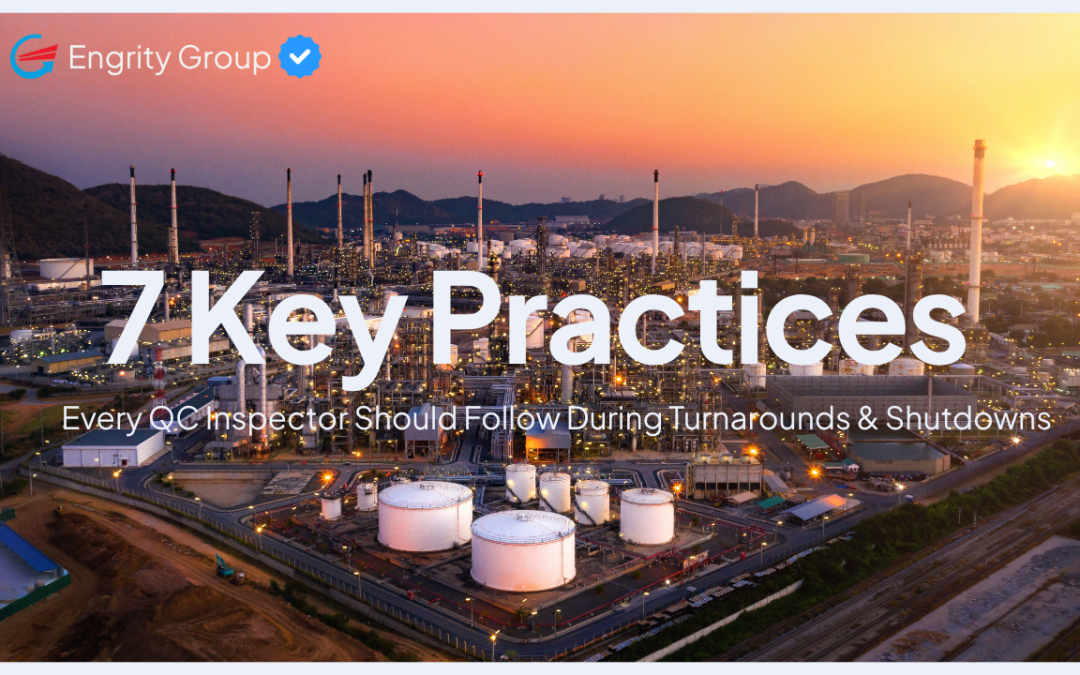
7 Key Practices Every QC Inspector Should Follow During Turnarounds and Shutdowns
Hello Everyone!
Turnaround and shutdown projects are some of the most demanding environments for Quality Control Inspectors.
Unlike routine construction or maintenance work, turnarounds often involve tight schedules, long shifts, multiple contractors, simultaneous work fronts, frequent repairs, and significant pressure to complete work safely and on time.
In this environment, a QC Inspector’s role goes beyond simply performing inspections and completing reports. Effective QC Inspectors need to be proactive, organized, technically knowledgeable, and able to communicate effectively with everyone involved in the work.
A strong QC Inspector helps identify potential quality issues early, supports timely resolution, maintains compliance with project requirements, and helps prevent unnecessary rework and schedule delays.
Here are 7 key practices that can help QC Inspectors succeed during turnaround and shutdown projects.
1. Know Your Scope
Before inspection activities begin, a QC Inspector should have a clear understanding of the work scope and the requirements that apply to it.
This includes reviewing:
- Drawings and specifications
- Inspection and Test Plans (ITPs)
- Approved procedures
- Applicable codes and standards
- Client specifications
- Acceptance criteria
- Material requirements
- Welding requirements
- NDT requirements
- Testing requirements
- Turnover and documentation requirements
Knowing the scope allows an inspector to understand what needs to be inspected, when it needs to be inspected, and what requirements must be met before work can proceed.
Turnarounds move quickly, so there may not always be time to stop and research requirements after an issue has already occurred.
Preparation before the work starts can make a significant difference.
A QC Inspector who understands the scope can recognize potential problems earlier and provide more effective guidance to the project team.
2. Plan Ahead
Turnaround work is highly schedule-driven.
An inspection that is not completed at the right time can hold up welding, NDT, pressure testing, reinstatement, or other downstream activities.
QC Inspectors should therefore understand what work is coming next, not just what is happening in front of them.
This means coordinating with:
- Supervisors
- Foremen
- Welders
- Contractors
- Engineers
- NDT Technicians
- Client Representatives
- Other QC Inspectors
For example, if a weld is approaching completion, the inspector should already be thinking about the next inspection requirements, such as visual inspection, NDT, repair documentation, or required hold points.
Planning ahead helps reduce waiting time and allows inspection resources to be positioned where they are needed most.
The goal is not to rush inspections. The goal is to anticipate the workflow so quality requirements can be completed without unnecessarily interrupting production.
3. Stay in the Field
One of the most effective practices for a QC Inspector during a turnaround is simply to stay connected to the work.
Being visible and present in the field provides a much better understanding of the actual work sequence than relying entirely on paperwork or updates from others.
Field presence allows inspectors to:
- Observe work as it progresses
- Identify potential quality concerns early
- Understand changing site conditions
- Verify that procedures are being followed
- Communicate directly with the people performing the work
- Anticipate upcoming inspection requirements
- Respond quickly when issues arise
A QC Inspector who understands the work sequence can often recognize a potential problem before it becomes a completed defect.
This can prevent costly repairs, delays, and unnecessary disruption to the turnaround schedule.
Being in the field does not mean constantly standing beside one activity. It means maintaining an active understanding of where the work is happening, what stage it is at, and what quality requirements are coming next.
4. Communicate Effectively
Quality control is highly dependent on communication.
During a turnaround, QC Inspectors regularly interact with welders, supervisors, engineers, NDT technicians, contractors, and client representatives.
Professional communication helps ensure that quality concerns are understood and addressed before they become larger problems.
QC Inspectors should build professional working relationships while maintaining their independence and responsibility for quality.
When a concern is identified, the objective should be to communicate it early, clearly, respectfully, and based on the applicable requirement.
Instead of allowing an issue to continue until it becomes a major problem, inspectors should raise concerns when they are first identified and work with the appropriate personnel to determine the correct path forward.
Good communication can help create a culture where quality concerns are treated as part of the process rather than as personal criticism.
The result is a more productive relationship between QC, production, contractors, and the client.
5. Never Assume — Always Clarify and Confirm
This is especially important during fast-paced turnaround work.
When schedules are tight and multiple activities are happening simultaneously, it can be tempting to rely on assumptions or previous experience.
However, assumptions can lead to mistakes, rework, non-conformances, and schedule delays.
If something is unclear, stop and verify.
A QC Inspector should ask questions such as:
- What drawing revision applies?
- Which procedure is approved for this activity?
- What is the required acceptance criterion?
- Is this an approved repair procedure?
- Has the required inspection hold point been released?
- What NDT method and extent are required?
- Has the material been verified?
- Has the client or engineering team provided clarification?
When necessary, obtain documented clarification or confirmation from the appropriate authority.
Asking a question is not a weakness. In quality control, clarification is part of the job.
The principle is simple:
Never assume. Always clarify and confirm.
6. Focus on Critical Activities
Not every activity presents the same level of quality risk.
QC Inspectors need to recognize the activities that can have a significant impact on the integrity, safety, and successful completion of the work.
During turnarounds, particular attention may be required around activities such as:
- Closure welds
- Repair welds
- Material verification
- Flange face inspection
- Bolt torquing and tensioning
- NDT
- Pressure testing
- Final reinstatement
These activities can have significant downstream consequences if requirements are missed.
For example, a missed inspection on a closure weld can potentially affect NDT, pressure testing, reinstatement, and turnover.
Similarly, issues with flange faces, bolting, or reinstatement can create problems after equipment is returned to service.
The QC Inspector should therefore prioritize activities based on risk, project requirements, inspection points, and potential impact on the schedule and equipment integrity.
7. Keep Documentation Current
Good inspection work is only part of quality control.
The inspection also needs to be properly documented.
During a turnaround, documentation can accumulate quickly. Waiting until the end of a shift—or worse, the end of the project—to complete records can create unnecessary problems.
QC Inspectors should keep documentation current throughout the work, including:
- Inspection reports
- Weld maps
- NDT records
- Material verification records
- Repair documentation
- Deficiency and non-conformance records
- Inspection releases
- Testing records
- Turnover documentation
Current documentation provides a clear record of what has been inspected, what remains outstanding, and what requirements have been satisfied.
It also makes turnover more efficient and reduces the risk of missing records later.
The best approach is to document the work as it progresses rather than trying to reconstruct the project afterward.
The Bottom Line
A successful turnaround QC Inspector does much more than identify problems.
They understand the scope, anticipate the work, stay connected to the field, communicate effectively, verify requirements, focus on critical activities, and maintain accurate documentation.
Most importantly, they help the project team address quality concerns before those concerns become costly repairs or schedule delays.
Turnaround environments can be demanding, but a proactive and disciplined approach to QC can make a significant difference.
Remember:
Be proactive.
Be professional.
Be reliable.
Never assume—always clarify and confirm.
Looking for QC Opportunities?
At Engrity, we support turnaround and shutdown projects with qualified QC professionals across Canada.
If you are an experienced QC Inspector looking for upcoming turnaround, shutdown, welding, piping, or QA/QC opportunities, connect with Engrity to learn about current and upcoming assignments.
Connect with Engrity for upcoming QC inspection opportunities.
Engrity Group
Building Confidence Through Quality and Compliance.
Experience the Difference
Contact
Phone
+1 (780) 800-6297
info@engrity.com
Address:
201-9403 63 Ave NW, Edmonton, AB T6E 0G2