
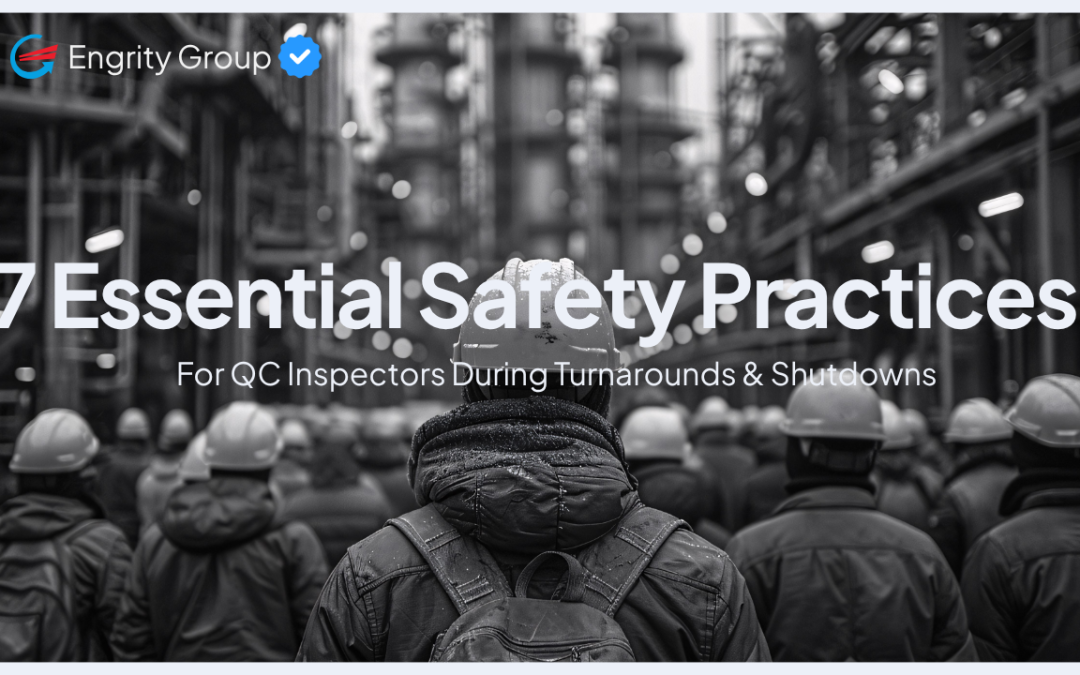
7 Essential Safety Practices
Hello Everyone!
Turnarounds and shutdowns are where the pace goes up, the hours get longer, and the phrase “we need this done yesterday” starts making its way into conversations.
For QC Inspectors, these projects can be some of the most demanding—and rewarding—assignments in the industry.
You may be dealing with multiple contractors, simultaneous operations, welding, NDE, confined spaces, lifting activities, hot work, temporary equipment, changing work fronts, and a schedule that seems to change every time you look at it.
And somewhere in the middle of all that, you’re expected to inspect, document, report, communicate, and maintain quality.
No pressure, right?
But while production schedules and deadlines are important, one thing should never be compromised:
Safety.
A QC Inspector isn’t just there to identify weld defects, dimensional issues, incomplete work, or documentation gaps. A good inspector also needs to recognize when the conditions around the inspection activity could create a safety risk.
Here are 7 essential safety practices that every QC Inspector should keep in mind during turnaround and shutdown work.
1. Know the Job—and Know the Hazards
Before you walk into the work area, you should understand what you are actually there to inspect.
That sounds obvious, but turnaround environments can change quickly.
You may arrive expecting to inspect piping welds and discover that the work area now has:
- Additional contractors working nearby
- Scaffolding being erected
- Crane or lifting operations
- Hot work
- Temporary electrical equipment
- Open floor penetrations
- Confined-space activities
- Heavy equipment moving through the area
- New barricades or restricted zones
- Simultaneous operations happening around your inspection location
The work you are inspecting may not have changed—but the environment around it might have.
Before starting:
Review the work scope
Know what you’re inspecting and what documentation applies.
Depending on the project, this could include:
- Inspection and Test Plans (ITPs)
- Quality Control procedures
- Weld maps
- Drawings
- Specifications
- Applicable codes and standards
- Procedures
- Work packs
- Permits
- Job Safety Analysis (JSA)
- Hazard assessments
- Site-specific requirements
Understand the hazards
Ask yourself:
What could hurt me?
Then ask:
What could change while I’m doing this inspection?
That second question is particularly important during turnarounds.
A work area that was perfectly acceptable 30 minutes ago may suddenly have a crane operating overhead, a welding crew setting up, or equipment moving through the area.
A simple rule:
Don’t inspect on autopilot.
Your eyes should be checking both the work and the environment around the work.
2. Attend the Pre-Job Meeting
The pre-job meeting isn’t just another meeting you attend because someone told you to.
It can be one of the most important opportunities to understand what is happening around you.
Turnaround projects often involve dozens—or even hundreds—of workers performing different activities simultaneously.
The welding crew knows what they’re doing.
The NDE technician knows what they’re doing.
The scaffolders know what they’re doing.
The crane operator knows what they’re doing.
The electricians know what they’re doing.
The problem?
All of them may be doing it in the same general area.
That means communication matters.
During the pre-job meeting, pay attention to:
- What work is planned for the shift
- Changes to the work scope
- New hazards
- Work area restrictions
- Permit requirements
- Isolation requirements
- Emergency procedures
- Simultaneous operations
- Changes in access or egress
- Lifting activities
- Hot work
- Confined-space work
- Changes in personnel or contractors
And don’t be afraid to ask questions.
If something isn’t clear, ask.
There is no prize for being the person who says:
“I thought someone else was handling that.”
3. Never Assume Equipment Is Safe—Verify Lockout/Tagout
One of the most important rules in industrial work is simple:
Never assume. Verify.
When working around equipment, piping, vessels, machinery, or systems that may contain stored energy, the required isolation and energy-control procedures must be followed.
Depending on the facility and task, hazards may include:
- Electrical energy
- Hydraulic pressure
- Pneumatic pressure
- Steam
- High temperature
- Chemical energy
- Mechanical energy
- Stored pressure
- Gravity
- Rotating equipment
- Process fluids
A piece of equipment can look completely inactive while still presenting a serious hazard.
That’s why Lockout/Tagout (LOTO) and isolation procedures exist.
If your inspection requires access to equipment or an area where isolation is required:
Know the site’s procedure.
Don’t rely on:
- “It’s already shut down.”
- “Someone told me it’s isolated.”
- “They worked on it yesterday.”
- “The operator said it’s safe.”
Your safety should never depend on assumptions.
Follow the site’s authorization, isolation, verification, and access requirements.
If the required controls aren’t in place, stop and escalate the issue.
4. PPE Is Not Optional—And Neither Is Wearing It Correctly
Let’s be honest.
Most inspectors have probably had that moment where they think:
“I’m only going in there for five minutes.”
Five minutes can become 30.
Thirty minutes can become two hours.
And suddenly you’re standing in an active work area wondering why you didn’t put on the correct PPE in the first place.
Your PPE requirements depend on the site and task, but may include:
- Hard hat
- Safety glasses
- Safety footwear
- High-visibility clothing
- FR clothing
- Gloves
- Hearing protection
- Respiratory protection
- Fall protection
- Face protection
- Specialized PPE
But PPE isn’t a substitute for hazard control.
Think of it as one layer of protection, not your entire safety strategy.
For example, if there is a fall hazard, wearing a hard hat doesn’t make the fall hazard disappear.
If there is an energized system, safety glasses don’t make it safe to approach.
If you’re entering an area with a respiratory hazard, your PPE needs to be appropriate for the hazard and used according to site requirements.
The key question isn’t:
“Do I have PPE?”
It’s:
“Am I wearing the right PPE for what I’m about to do?”
5. Stay Aware of Your Surroundings
This is one of the biggest challenges during turnarounds.
Your inspection might be focused on a weld, flange, pipe spool, vessel nozzle, coating system, or fabrication detail.
But the work environment doesn’t care that you’re concentrating on your inspection report.
Things can be moving around you.
Literally.
You could have:
🚧 Equipment moving
🏗️ Scaffolding being installed
🏗️ Overhead lifting
🔥 Hot work
⚡ Electrical work
🧪 Process hazards
🕳️ Openings and excavations
⬆️ Work at height
🚪 Restricted access
🚜 Mobile equipment
And you’re standing there with your inspection checklist thinking about whether the weld meets the acceptance criteria.
That’s why situational awareness matters.
Before entering an area, take a moment.
Look around.
Listen.
Identify what’s happening.
Ask yourself:
Where are the workers?
Where is the equipment?
Where are the exclusion zones?
Where are the access and exit routes?
Is anything happening overhead?
Has anything changed since I was last here?
That 10-second pause can be more valuable than rushing into the area.
6. Never Take Shortcuts Because the Schedule Is Tight
Turnarounds are famous for schedule pressure.
Everyone wants the work completed.
Production wants the equipment back online.
Construction wants the work finished.
The project team wants milestones achieved.
The client wants progress.
And the inspector?
The inspector still has to follow the requirements.
Schedule pressure should never be an excuse to bypass safety or quality controls.
That means not ignoring:
- Permit requirements
- Barricades
- Exclusion zones
- Fall protection
- Confined-space requirements
- Isolation procedures
- PPE requirements
- Site access restrictions
- Required inspections
- Quality hold points
- Documentation requirements
There is a dangerous mindset that sometimes appears during high-pressure work:
“We’ve done this a hundred times.”
That’s exactly when complacency can become a problem.
Experience is valuable.
But experience should help you recognize hazards—not convince you that hazards don’t exist.
Remember:
A shortcut might save five minutes.
An incident can change someone’s life.
No schedule is worth that.
7. Stop and Speak Up
This may be the most important practice on the list.
If something doesn’t look right, say something.
You might notice:
- An unsafe work condition
- Missing barricades
- An unexpected change in the work area
- Incorrect PPE
- Unsafe access
- Uncontrolled equipment movement
- A change in isolation conditions
- A new hazard
- Conflicting simultaneous operations
- A damaged scaffold
- An unexpected release or leak
- Workers entering a restricted area
You don’t have to be the safety manager to recognize something unsafe.
And you don’t need to wait until something happens.
Stop.
Assess.
Communicate.
Escalate when necessary.
The goal isn’t to blame someone.
The goal is to prevent an incident.
A professional inspector should be comfortable saying:
“Hold on. Something has changed here.”
That one sentence can start a conversation that prevents a much bigger problem.
Quality and Safety Go Hand in Hand
It’s easy to think of quality and safety as two completely separate responsibilities.
They aren’t.
Poor quality can create safety concerns.
And unsafe working conditions can affect the quality of the work.
For example, if workers are rushing because of schedule pressure, the risk of mistakes can increase.
If access to an inspection area is unsafe, the inspection itself may be compromised.
If proper procedures aren’t followed, both quality and safety can be affected.
That’s why professional QC inspection isn’t simply about checking boxes.
It’s about understanding the entire work environment.
A strong inspector understands:
What is being built.
How it is being built.
What standards apply.
What hazards exist.
What could change.
And when something needs to stop.
The Turnaround Inspector Mindset
Working on a turnaround requires a different mindset from working on a slower-paced project.
You need to be:
Observant
Don’t just look at the item you’re inspecting. Look at the environment.
Communicative
Talk to supervisors, workers, engineers, safety personnel, and other inspectors.
Professional
Maintain your inspection standards even when everyone around you is under pressure.
Adaptable
Work scopes and priorities can change quickly.
Safety-conscious
Don’t allow schedule pressure to override safety requirements.
Confident
If something is wrong, speak up.
And perhaps most importantly:
Don’t become complacent.
The fact that you’ve walked through the same area 20 times doesn’t mean the 21st time is automatically safe.
A Quick Turnaround Safety Checklist for QC Inspectors
Before starting your shift, ask yourself:
☐ Do I understand today’s work scope?
☐ Have I reviewed the applicable JSA/hazard assessment?
☐ Do I know the site-specific requirements?
☐ Have I attended the required pre-job meeting?
☐ Do I understand the isolation/LOTO requirements?
☐ Am I wearing the required PPE?
☐ Do I know what’s happening around my work area?
☐ Are there simultaneous operations I need to be aware of?
☐ Do I have safe access and egress?
☐ Are there overhead, lifting, hot-work, or mobile-equipment hazards?
☐ Have conditions changed since my last inspection?
☐ Do I know who to contact if I identify an unsafe condition?
And finally:
☐ Am I willing to stop and speak up if something doesn’t look right?
If you can answer these questions before starting your work, you’re already taking an important step toward a safer shift.
A Successful Turnaround Isn’t Just About the Schedule
Turnarounds are measured in many ways.
Completed work.
Milestones.
Production readiness.
Quality records.
Inspection reports.
Punch-list closure.
But there’s one measurement that matters more than all of them:
Everyone goes home safely.
The best turnaround is not the one where everyone worked the fastest.
It’s the one where the work was completed safely, correctly, and professionally.
So whether you’re a QC Inspector, welding inspector, NDE technician, supervisor, engineer, tradesperson, or project coordinator, remember:
Know the job.
Understand the hazards.
Follow the procedures.
Stay aware.
Communicate.
Never take shortcuts.
And if something doesn’t look right—stop and speak up.
Because at the end of a long turnaround shift, the most important box to check isn’t on your inspection report.
It’s “Everyone Home Safe.”
Looking for QC Inspection Opportunities?
At Engrity Group, we support professional QA/QC inspection services for turnaround, shutdown, construction, and industrial projects across Canada.
We’re always interested in connecting with qualified inspection professionals, including:
- CWB Certified Welding Inspectors
- QC Inspectors
- API 510 Inspectors
- NDE/NDT Technicians
- Coating Inspectors
- QA/QC Professionals
If you’re an experienced inspection professional looking for your next project opportunity, connect with Engrity Group and stay tuned for upcoming opportunities.
Connect with Engrity for upcoming QC inspection opportunities.
Engrity Group
Building Confidence Through Quality and Compliance.
Experience the Difference
Contact
Phone
+1 (780) 800-6297
info@engrity.com
Address:
201-9403 63 Ave NW, Edmonton, AB T6E 0G2